
Accreditation Framework
The Road Safety GB Academy has developed an accreditation framework for road safety practitioners to formally recognise the awareness, knowledge and experience of road safety professionals.
This approach comes in the form of two Awards to support road safety professionals who want to grow their expertise and make a real impact on safe, sustainable, and healthy travel.
The Awards are aimed at people working in, or developing a career in, road safety and active travel, with each Award reflecting different levels of professional practice.
- RSGB Certificate in Delivery of Safe, Sustainable and Healthy Travel
This Award is aimed primarily at practitioners who deliver road safety or active travel interventions. It provides a broad foundation of knowledge and skills for effective professional practice. - RSGB Diploma in Delivery and Management of Safe, Sustainable and Healthy Travel
This Award is aimed at experienced or advanced practitioners whose roles involve greater responsibility for the development, management and evaluation of interventions, projects or programmes, including working with partners and applying evidence to professional practice.
Detailed information on each Award is provided below.
Fees
There are a range of options available.
Option 1: Pay in Full
For those new to the RSGB Academy or those wishing to purchase the qualification package upfront.
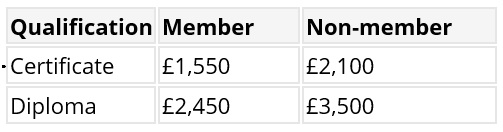
This option provides a discount of approximately 10%, depending on the courses selected. In addition, the price is fixed for the full duration of the award, protecting against future price increases.
Option 2: Pay in Two Instalments
Same qualification package as Option 1 completed in two payments.

Option 3: Prior Learning Route – One Transaction
For members who have already completed some Academy training within the last 5 years.
Candidates pay:
- the enrolment & support fee; and
- the cost of any additional courses required to achieve the Award
For example:
Certificate: enrolment & support fee (sliding scale £150-£300 depending on support required, this will be calculated on registration) + remaining courses required
- Diploma: enrolment & support fee (sliding scale £200-£400 depending on support required, this will be calculated on registration) + remaining courses required
The costs of the remaining courses required would be added together and paid for with the enrolment & support fee in one transaction.
Option 4: Prior Learning Route – Pay As You Progress
For members who have already completed some Academy training within the last 5 years.
Candidates pay:
- the enrolment & support fee; and
- the cost of any additional courses required to achieve the Award on a Pay As You Progress basis
For example:
- Certificate: enrolment & support fee (sliding scale £150-£300 depending on support required, this will be calculated on registration) + pay for additional courses on an individual Pay As You Progress basis
- Diploma: enrolment & support fee (sliding scale £200-£400 depending on support required, this will be calculated on registration) + pay for additional courses on an individual Pay As You Progress basis
Interested in an Award
To register click here to download the registration form.
The Academy can provide further information about the Awards, the courses you will need to complete and how previous RSGB Academy courses or other relevant learning may count towards your Award, please contact Sally Bartrum Road Safety GB Academy Administrator.
RSGB Certificate in Delivery of Safe, Sustainable and Healthy Travel
To achieve the Certificate, learners will complete four core courses (shown in red) and choose two additional courses (shown in blue)
If learners have completed any of the required courses within the last five years, these will count towards the Certificate and do not need to be repeated. If a course was completed more than five years ago, it must be refreshed.
The only exception is the Road Safety Practitioner Foundation Course. This is a four-day course, but if it was completed more than five years ago, learners only need to complete a one-day refresher to update their knowledge.
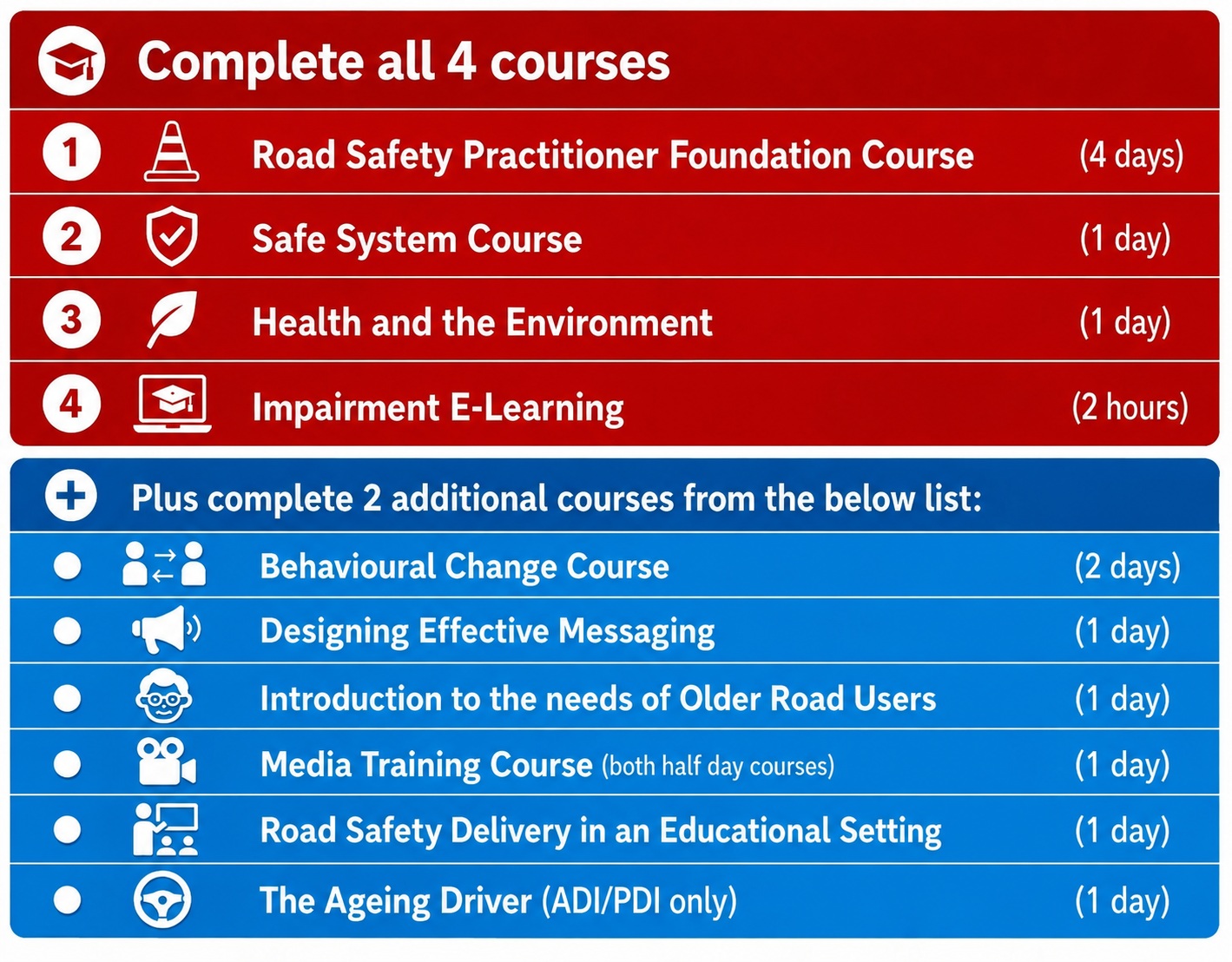
RSGB Certificate in Delivery of Safe, Sustainable and Healthy Travel, learning outcomes
On completion of the Certificate, learners will be able to demonstrate appropriate awareness, knowledge and practical skills relevant to the delivery of safe, sustainable and healthy travel interventions.
Awareness of:
- How their role fits within and interacts with the Safe System approach to road safety
- The role of partners within the Safe System
- Why behaviour change interventions should be informed by behavioural theory
- The importance of using appropriate behaviour change techniques
- The importance of using statistical evidence to support the development of interventions
- Learning theories and their relevance to educational interventions
- Common causes and contributory factors associated with road collisions
- The importance of promoting safe and active forms of travel
- The importance of robust evaluation
- Where to access relevant road safety research and evidence
Knowledge and practical understanding of:
- The importance of risk assessment and how to complete a risk assessment in accordance with relevant legislation and guidance
- The ways in which impairment can affect road user behaviour
- How behaviour change techniques can be incorporated into interventions
- How learning theories can inform the delivery of educational interventions
- How digital technology can be used effectively to support and enhance learning
- How active learning and client-centred approaches can be used
- How to plan and deliver an educational intervention
- How to work effectively with partners in the planning and delivery of interventions
- How evidence and evaluation findings can be used to support and improve professional practice
- How transport can affect health and the environment
- Routes to further professional development
Assessment
For most courses, assessment takes the form of a written assignment assessed by an Academy assessor. Learners receive feedback on their work and, where necessary, will be given an opportunity to address areas where the required assessment criteria have not yet been demonstrated. Where a written assessment would present a barrier to a learner, an appropriate alternative assessment method may be agreed with the Academy.
RSGB Diploma in Delivery and Management of Safe, Sustainable and Healthy Travel
To achieve the Diploma, learners will complete seven core courses (shown in red) and choose two additional courses (shown in blue)
If learners have completed any of the required courses within the last five years, these will count towards the Diploma and do not need to be repeated. If a course was completed more than five years ago, it must be refreshed.
The only exception is the Road Safety Practitioner Foundation Course. This is a four-day course, but if it was completed more than five years ago, learners only need to complete a one-day refresher to update their knowledge.
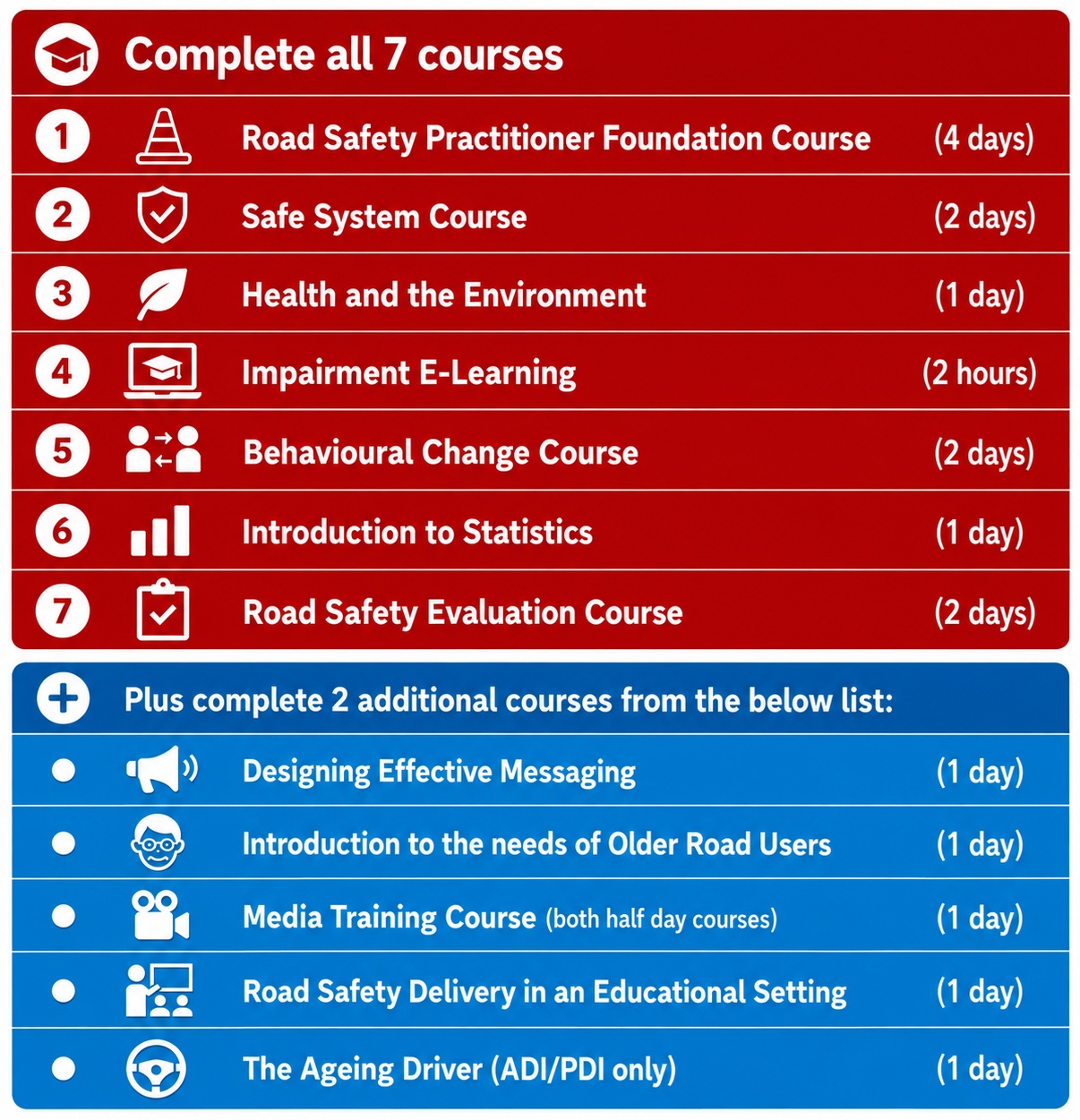
RSGB Diploma in Delivery and Management of Safe, Sustainable and Healthy Travel, learning outcomes
Knowledge, understanding and application of:
- The main principles and concepts underpinning the Safe System approach to road safety
- How their professional role fits within and contributes to the Safe System
- The role of partners and effective partnership working within the Safe System
- How behavioural theories can be used to identify determinants of behaviour and inform the development of interventions
- How to select and apply appropriate behaviour change techniques when developing interventions
- How statistical evidence can be interpreted and used to support the development and evaluation of interventions, including recognising its limitations
- Common causes and contributory factors associated with road collisions and their implications for intervention development
- The role of safe and active forms of travel within safe, sustainable and healthy transport
- The ways in which impairment can affect road user behaviour
- How learning theories can inform the design and delivery of educational interventions
- How digital technology can be used effectively to support and enhance learning
- How active learning and client-centred approaches can be applied
- How to plan, develop, deliver and evaluate educational interventions
- How transport can affect health and the environment
- How to plan and manage projects
- Principles of financial management relevant to road safety and related projects
- How to identify, critically interpret and apply road safety research and evidence to professional practice
Application of knowledge and skills through experience of:
- Planning, developing and evaluating road safety, active travel or related interventions
- Delivering, or managing the delivery of, road safety or active travel interventions, projects or programmes
- Using data, research and other evidence to inform professional decisions
- Working collaboratively with partners and contributing to or leading partnership activity
- Applying appropriate behaviour change and learning principles to the development of interventions
- Using evaluation findings to review and improve interventions and professional practice
- Supporting the development of colleagues and other practitioners
- Applying learning and evidence within their own professional practice
Assessment
For most courses, assessment takes the form of a written assignment assessed by an Academy assessor. Learners receive feedback on their work and, where necessary, will be given an opportunity to address areas where the required assessment criteria have not yet been demonstrated. Where a written assessment would present a barrier to a learner, the Academy may agree on an appropriate alternative assessment method.
Diploma Portfolio
In addition to completing the required courses and assessments, learners working towards the Diploma must complete a portfolio of evidence demonstrating how they have applied their learning within a road safety, active travel or related project or programme of work.
The portfolio provides learners with an opportunity to demonstrate the practical application and integration of knowledge gained through the Diploma.
The portfolio will be considered as part of a final review by an independent Academy review panel.
General Points
Accreditation of Prior Learning (APL)
Road Safety GB recognises that learners may already have relevant knowledge and learning gained through previous formal study. Learners who have completed a relevant formal qualification or other recognised learning may apply for Accreditation of Prior Learning (APL).
The Academy will consider whether the previous learning provides sufficient and current evidence against the learning outcomes and assessment requirements of the relevant RSGB Academy course. Where appropriate equivalence is demonstrated, the learner may be exempted from completing some or all of the learning associated with that course.
The Academy may use a gap analysis to identify whether any additional learning or assessment is required before equivalence can be confirmed. APL decisions are made by the Academy and recorded as part of the learner's Award record.
Continued Professional Development (CPD)
Achieving an Award represents an important stage in professional development, but road safety practice and the evidence that supports it continue to evolve.
To maintain the currency of an Award, learners are expected to undertake at least one day of relevant Continuing Professional Development (CPD) each year.
This could include:
- Completing a Road Safety GB Academy course
- Attending the National Road Safety Conference
- Attending another relevant conference, seminar or workshop
- Completing another relevant learning opportunity that supports the learner's professional role
Learners are encouraged to maintain a record of their CPD activities.